The Pendulum of the Mind: Living Beyond Like and Dislike
July 17, 2026Wildfires Outside and the Fire Within: Reflections on Ayurveda and Balanced August Living
July 31, 2026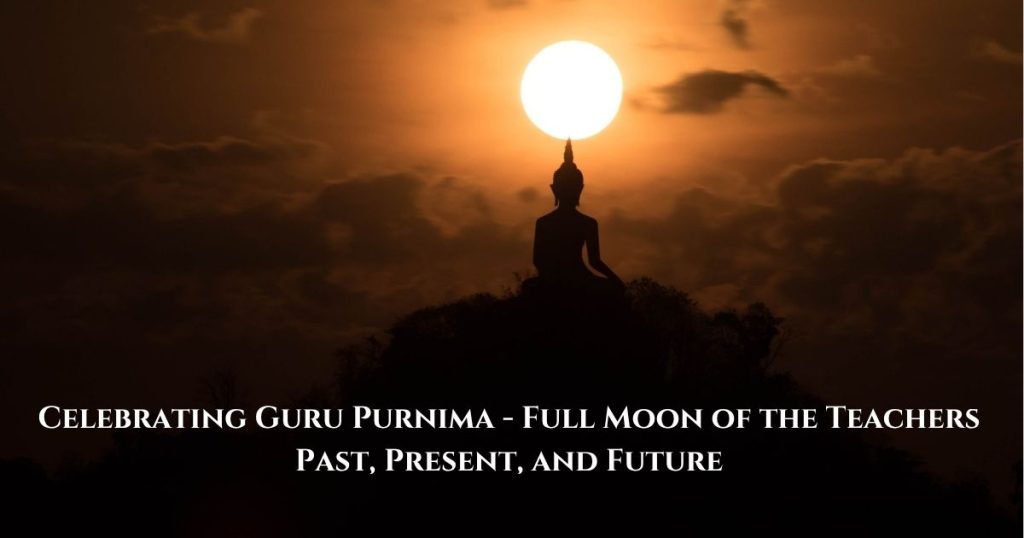
July brings us a special day in the Yoga calendar: the full moon celebrated throughout India as Guru Purnima – the Full Moon of the Gurus. On this day, teachers of the past, present and future are honoured, and gratitude is offered for the wisdom that has been passed down through the ages.
Purna means “full” in Sanskrit, and Purnima refers to the moon in its fullness. As for the word guru itself – let us look a little more deeply, so that we may understand the essence of this special day.
Guru is often understood to mean the one who dispels the darkness of ignorance. Gu means darkness and ru means remover.
There is another equally beautiful way of understanding this word. Students of Ayurveda will recognise guru as one of the twenty qualities (gunas) that describe the natural world. These qualities are arranged in ten pairs of opposites that permeate all of existence. Guru means heavy, its opposite being laghu, meaning light.
Perhaps this gives us another insight into the nature of the guru. The guru is “heavy” – not in body, but with the weight of wisdom born from direct experience and understanding. Grounded in truth, the guru shares that wisdom not to create followers, but to help remove the veils that prevent us from recognising our own true nature.
This is what is celebrated on Guru Purnima. Yoga practitioners across the world join in honouring the blessings of the teachings that have been passed down through countless lineages: the words, practices and insights of those who have explored the deepest questions of human existence.
Why the full moon of July?
One explanation lies in the rhythm of the seasons. By July, the monsoon has usually arrived across much of India. Traditionally, wandering sages and sadhus would cease their travels during this time, remaining in one place during the rains and sharing their wisdom with those who gathered around them.
This full moon is also known as Vyasa Purnima, in honour of the great sage Vyasa, regarded as the Adi Guru — the first teacher. While we cannot know with historical certainty why this day became associated with Vyasa, tradition holds that it marks either his birth or the completion of his work of arranging and transmitting sacred knowledge.
Vyasa is traditionally credited with compiling the Mahabharata, the great Indian epic within which we find the Bhagavad Gita. He is also said to have organised the vast body of Vedic knowledge into the four Vedas and compiled the Puranas – collections of stories, philosophy, cosmology and teachings that made spiritual wisdom accessible through narrative.
And so, Vyasa represents not only one teacher, but the entire stream of wisdom flowing from teacher to student, generation after generation.
But why are the gurus honoured under the light of the full moon?
The moon itself offers us a beautiful teaching. The moon does not create its own light; it reflects the light of the sun. In the same way, the true guru does not claim ownership of wisdom. Having awakened to the light of consciousness, the guru reflects that light so clearly that we are able to recognise it within ourselves.
The guru points us towards the truth that has always been present: that beneath the layers of conditioning, fear and forgetfulness, there is a deeper essence within us connected to the source of all existence.
Like the Zen saying: do not look at the finger pointing towards the moon; look at the moon itself. The guru is not the destination. The guru is the one who points us towards our own awakening.
This is an important remembrance. There is the outer guru – the teacher who appears in human form – and there is the inner guru: the quiet wisdom, intuition and discernment (buddhi) that dwells within the heart.
A true teacher does not encourage dependence. The purpose of the guru is not to become a crutch, but to help us grow wings. The guru is a guide towards our own direct experience of truth.
Perhaps this is why even the imperfections of teachers can become part of our learning. In our human tendency to place teachers on pedestals, we can forget that they too exist within the complexities of human life. Ultimately, the deepest responsibility for our awakening rests with us. The sincerity of the seeker, the willingness to look deeply, and the commitment to practice are what allow wisdom to transform us.
My first Guru Purnima was in an ashram in India during the monsoon season. I had never heard of Guru Purnima before that time. I was in my twenties and a new explorer of both the outer and inner worlds.
I joined hundreds of others in a joyful celebration beneath a canvas roof in a bamboo grove. At the end of the evening, thousands of rose petals were released from above, showering over everyone gathered – a symbol of the blessings of the gurus of all times, always available to us when we have the heart and mind to receive them.
It was an evening I will never forget.
It is said that when the student is ready, the teacher appears. Perhaps we are blessed today more than ever before. The teachings of the sages are available to us in ways unimaginable to previous generations. Their books, talks and practices are accessible every day.
Yet wisdom is not simply gathered through information. It is cultivated through practice: through yoga postures, breath, meditation and the balanced way of living that systems like Ayurveda teach us. Through these practices, we awaken our inner intelligence and strengthen our capacity for discernment. We become better able to hear the quiet voice of our inner teacher. We learn to recognise what is aligned and meaningful for us, and what is simply another mental construct inviting us to add more ideas to the mind rather than deepen our understanding. Traditionally, the student committed deeply to one path and one teacher. There is wisdom in this dedication, for scattering our attention across many paths can prevent us from going deeply into any one of them. Depth requires commitment.
And yet, until the right teacher or path appears, we can continue our practice, nurture our relationship with the inner guru, and allow the teachings that come to us to support our evolution.
Little by little, the veils of ignorance are lifted. The light of understanding expands. Our hearts open, our minds soften, and our lives become a greater expression of compassion, joy and service.
So on this Guru Purnima, perhaps we can pause and ask:
Who or what has been my guru? What has life been teaching me? Where have I been guided towards greater wisdom, love and truth?
For we all have gurus in our lives – sometimes in the form of a teacher, sometimes through another person, sometimes through challenge, and sometimes through the quiet wisdom that arises from within.
The light is always there. The guru – whether inner or outer – simply helps us remember how to see it.
Enjoy this meditation on the Inner Guru, and don’t forget to subscribe to my YouTube channel for more guided meditation and Yoga practices.
