LIFE – Looking Inward for Enlightenment
November 9, 2025The Quiet Flame of Discernment – Viveka
May 17, 2026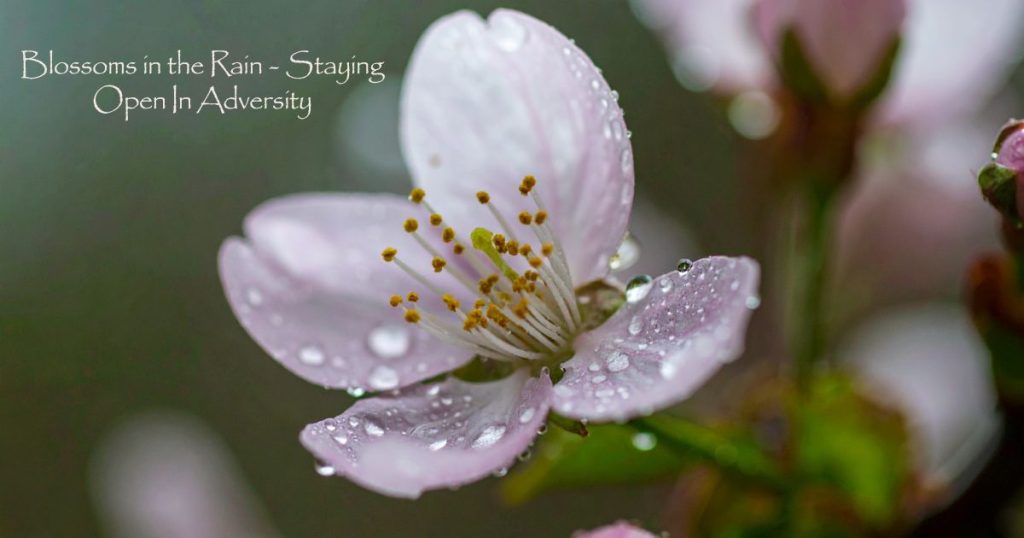
I have a beautiful old apple tree in the centre of my garden—an English early red variety, sweet as anything. Each spring, around about now, it offers the most delicate white blossom.
I love watching the unfolding of blossoms in my garden through the season. First, my cherry tree brings a hint of colour. Then the camellia—tall and reaching for the light—bursts into pink. Forsythia follows, then lilac. And finally, my apple tree, which a few weeks after blossoming begins to scatter its petals like nature’s soft confetti across the garden.
It’s a delight to witness each year.
As I’ve watched this quiet unfolding this year, I’ve found myself thinking about April showers. Though we haven’t had many lately, these weekly reflections often draw me to notice how the changing seasons mirror the human experience in subtle and meaningful ways.
Even the most delicate blossoms bravely receive the rain, I thought. They do not resist it, nor harden against it. In spite of the harshness of rains and winds, they stay soft, endure, and continue opening to the Spring sunlight when the rains have passed. And have you noticed how when the rain passes, the petals seem almost illuminated—light catching on the droplets that remain.
There is a deep teaching for us in this seasonal happening as we too inevietably have to meet our own share of rains in life.
One way in which these rains can show is in those times that we are misunderstood, judged, or treated unfairly. We know that in these moments, we can either harden and guard ourselves… or remain open, steady, and receptive – aware and watchful of what arises within us in response, without being overtaken by it.
The watching, the remaining open and steady is not an easy practice, of course In fact, it is often the most challenging precisely when it would most benefit us to practice it.
This week I found myself in a situation where a misunderstanding arose around my new rescue dog and her training. What, in truth, was being handled with care and responsibility, began to be reported quite differently. It only takes one or two for a narrative to quickly form that doesn’t reflect the truth, right? My first instinct was to explain, to correct, to make things clear. I could feel a tightening within – an urge to defend and preserve my long place as a good and responsible neighbour.
And yet, I paused. I did not follow that urge, strong as it was.
I realised that responding in that moment, would likel fuel the stories rather than bring clarity. And so, I chose – at least for the time being – to remain quiet.
To let the moment pass without reacting.
This was not suppression, or fear or weakness, it was a consciously chosen practice. It was, I believe, what my teachers have taught for years – Yoga in action.
In Yoga, there is a teaching often expressed as “bear insult, bear injury.”
At first hearing, it can sound heavy or even passive. However, in essence, it points to something far more refined: the ability to remain steady and not be carried by reaction – even when something feels unjust.
When we are challenged, the impulse to defend, correct, or push back is immediate and deeply conditioned. It arises before we’ve had time to consider it.
This practice invites another way. It invites us to first pause – even just for a moment, to feel what is arising and not to run with the first wave of thoughts and emotions. It is not about suppressing or denying thoughts and feelings. It is a practice of letting them be, yet staying steady and unprovoked.
In this pause, something shifts. A capacity to truly respond – free from the hook of conditioned reactivity….that we know has caused us so much trouble in the past – becomes possible, if a response is needed.
Waiting gives awareness space to step in. And from that awareness, a different kind of action becomes possible – one that is guided by clarity and that is more aligned with the truth of who we are. We know we are not our reactivity – it just for the most part gets the better of us so many times.
This does not, on the other hand, mean we become passive or allow ourselves to be walked over. Quite the opposite.
As I heard one wise teacher from Rishikesh once say, “Everything is Ishwara—but sometimes we must put up our boundaries.”
Ishwara is that divine thread that is the source of all life – the embodiment of the divine.
The yogic path is not about abandoning ourselves. It is about learning to respond from a place that is steady, clear, and free from unnecessary conflict.
There is an old story of a snake who was taught not to bite, in the spirit of non-violence. The snake became so passive that people began to harm it. When the teacher returned, the snake complained about this, to which the teacher replied:
“I told you not to bite… but I did not tell you not to hiss.”
This is the distinction. We do not react in anger or aggression—but neither do we collapse or disappear. And we learn about boundaries – how and when to put them up. That is, we learn when and how to hiss.
We remain rooted, aware, and, when needed, quietly firm.
And so what we begin to see, through practice, is that not every situation requires a reaction and that there is action in inaction.
In fact, many situations soften when we do not immediately engage with them. When we do not feed them with further energy, they often lose their momentum.
It requires an amount of inner strength from us to respond in this way. It can be misunderstood. I experienced this, this week. “Don’t be walked over” my family told me, “Stand up for yourself,” – which meant go on the defensive attack. In this approach, others – and even our own inner voice – may judge our quietness as weakness. In truth, we are taking the bold step of allowing a different kind of strength entirely, a quieter strength. It is the strength to remain anchored within, rather than being pulled into the turbulence of what is arising in the moment.
It is the soft strength of blossoms in the rain.
This is where the practices we’ve been exploring in recent weeks – of awareness, of creating inner space – begin to truly matter. Without that inner space, we have no choice but to react. Once we have nurtured it and familiarised ourself with it, something new becomes possible.
Then we can experience a surge of emotion and not be consumed by it. We can witness the impulse to indignantly defend arising… and watchfully allow it to be. And – what a triumph – we can respond in a way that supports clarity and harmony, instead of conflict.
Sometimes we will see that the best response is simply to do nothing. At times, it may be to speak – clearly, calmly, and from a grounded place. And at times it may be silence.
Either way, the precious takeaway is that we are no long bound to act from our wounding. We are able to respond from awareness.
This is considered one of the highest practices in Yoga. It asks for awareness in the moment, a readiness to be emotionally honest with ourselves, to restrain urges without suppression and denial, and to hold ourselves to a new kind of strength, uncoloured by aggression
This practice is a movement towards freedom from the conditioned patterns that have long governed our reactions. It is a movement, in the collective, towards a world where the tenet of ahimsa – non violence – rules, and peace and love have the chance to thrive.
And so, like the spring blossoms – we learn to remain soft and delicate but also quietly resilient. Like the petals of spring, we do not resist the rains yet neither do we lose ourselves in them. We remain rooted in our own nature, in the spaciousness of the inner heart – open, receptive and loving.
May this be our remembrance this week. When something challenges us – when we feel misunderstood or unsettled – let’s resolve to stop for just for a moment. To take a breath and let the first surge of reactivity pass. To remain steady within ourselves in this way, spacious. In that spaciousness, may we witness a new way of being and a new capacity to respond begin to emerge.
With love and warmth,
Sara Shama
PS Get our weekly email with inspirational blogs, enquiry and awareness practices, meditations and the latest offers from Heart of Ayurveda.
